Sports: The Universal Language

On this blog, we often talk about the life-saving work that IIA, our partners, and the greater Akron community do every day to help refugees settle into their new home. Starting over in a new country is never easy, but the fact that our community is always there to embrace new residents with open arms, a hot meal, and an offer of friendship means the world. 

One way we bond is over the shared passion of organized sports. Immigrants and refugees are increasingly reaching the elite levels of U.S. sports in ways that may seem surprising, given the sports’ identification with U.S. culture.

In fact, all this shows is that we have more in common than our differences.  

Did you know 34% of Minor League Baseball players in Ohio, Kentucky, Indiana, and Michigan are immigrants, in contrast to 5% of the populations there? In “The Changing Face of Sport,  Ozy points out, America’s national pastime “plays a major role in building bridges between rural communities that are overwhelmingly white and people from other cultures.”

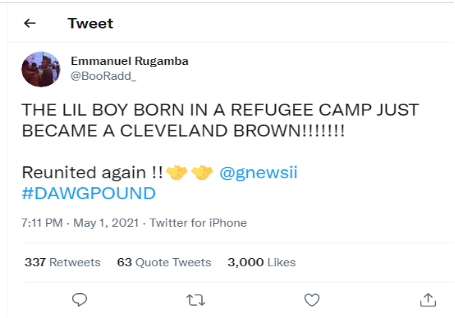
IIA was so excited when Emmanuel Rugamba became the first Rwandan-American in the National Football League, signing with our beloved Cleveland Browns. Rugamba was born in a refugee camp in Zambia and came to the U.S. with his mother at the age of three. After playing college football for the University of Iowa and Miami University, Rugamba signed with the Browns as a free agent. When the news broke, he tweeted, “THE LIL BOY BORN IN A REFUGEE CAMP JUST BECAME A CLEVELAND BROWN!!!!!!!” 
unnamed.png

Sadly, Rugamba has since been waived by the Browns and became a free agent once again. But he has a bright future ahead of him and we will be watching him succeed!

ESPN called Kwity Paye “the NFL’s most extraordinary prospect,” and he was a first-round (number 21) draft pick for the Indianapolis Colts in 2021. Coming to the U.S. as a baby and a refugee from Liberia, Paye hopes to use his NFL platform to uplift the immigrant experience and the need for immigration  law reform. 

The Olympic Refugee Team has helped educate the world about displaced people, giving them positive visibility on the international stage. Masomah Alizada fled from Afghanistan to France with her family in 2017 after she and her cycling friends were threatened by the Taliban. She joined the Olympic Refugee Team “to show all the men who thought that cycling isn't a women's thing, that I have made it all the way through to the Olympics. And if I can do it, any woman who wants to be involved in cycling, they can do it, from any country, like Afghanistan.”

In the 2020 Tokyo Games, which took place in 2021, 29 athletes from 11 different countries of origin competed in 12 sports as diverse as cycling, weightlifting, flatwater kayaking, and badminton. But the organization is also drawing controversy, over funding not making its way to the athletes and a perceived effort to deny them agency.
Akron North Girls Soccer Team 2021.jpeg

Photo used with permission from Akron North Athletics Department.

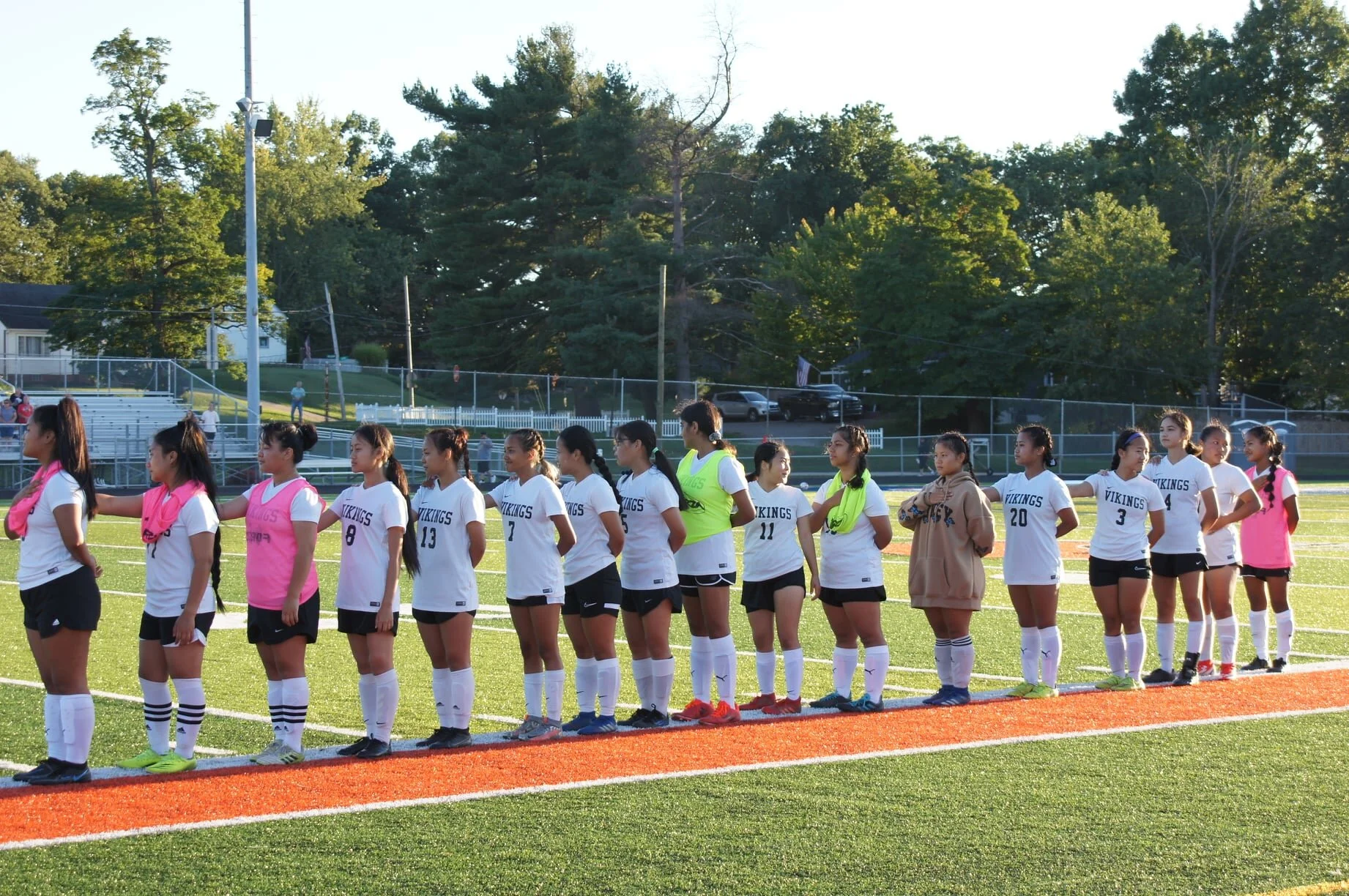
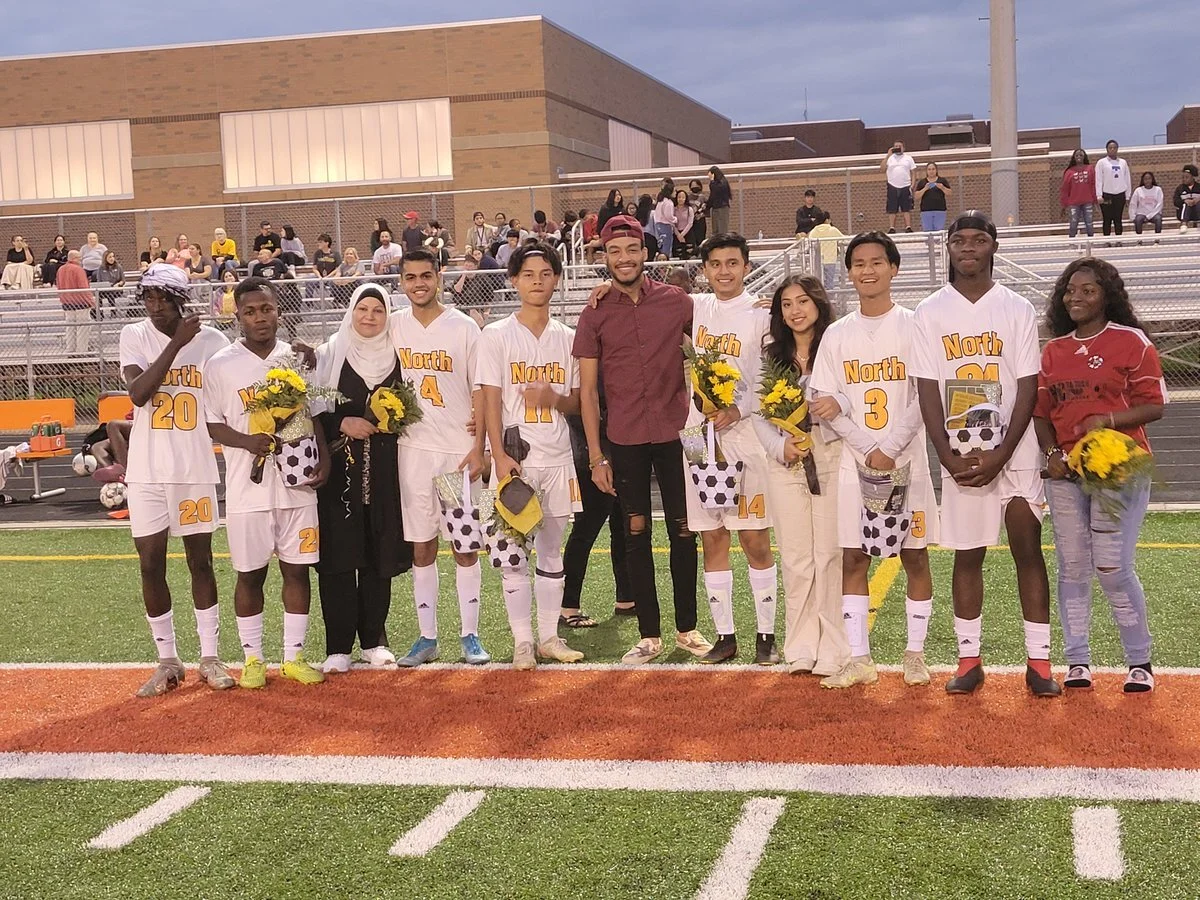
Here in Akron, there’s no question that former refugees and immigrants—and U.S. born Americans—look up to the aforementioned sports heroes and aspire to be like them one day. At North High School alone, half the student body is made up of young people who came to the U.S. as refugees. According to the district website, “1,800 of our students have a language other than English as their first language; and 45 different languages are now spoken in Akron Public Schools.” These cultures and languages are represented on the men’s and women’s soccer teams, for example.

As former men’s coach Michael Kane explained: “Soccer is called the world sport. You don’t necessarily need to speak to play.” 

Now led by Head Coach Emily Johnson, the men’s team won the Akron City series this year, and plays the first game of the postseason on October 20th at Boardman. 
Akron North Boys Soccer Seniors 2021.jpeg

Photo used with permission from Akron North Athletics Department.

“We Became Like Family” - IIA Prepares to Welcome More Akronites From the Congo

We continue our celebration of “Welcoming Week,” a nationwide effort to build connections between neighbors of all backgrounds, with a spotlight on our new Akron neighbors from the Democratic Republic of the Congo. 

People in the Democratic Republic of Congo have been dealing with one of the longest, most complex humanitarian crises in the world. The most recent crisis was sparked by escalated conflict in 1994; since then, millions have been forced from their homes. 

As a nation rich in natural resources, the Congo has been exploited for centuries. Rebel groups fill the power vacuum left by poor governance and rampant corruption. National armies seek control of the country’s abundant mineral wealth, sparking constant violence impacting families and entire communities. 

Not only have Congolese people endured years of armed conflicts and forced displacement, but food insecurity and multiple recurring epidemics have taken a heavy toll. The COVID-19 pandemic worsened the situation, causing another major blow to the country’s economy and increasing hunger and poverty even more.

For these reasons and more, the International Institute of Akron continues to welcome Congolese people to Ohio and help them resettle in their new homes, with vital help from our partners, neighbors, and volunteers.

Eka Anthony, an IIA Refugee Resettlement Support Specialist, fled the Congo in 2007 and finally came “home” to Akron in 2015, helped by World Relief, a former resettlement agency in Akron that had to close due to the lack of federal support for refugees under the Trump administration. 

Anthony said, “[they] welcomed me and picked me up from the airport, took me to a house… They gave us clothing, furniture, kitchen supplies... I had people [volunteers] show me around, how to navigate the community. We became like family.”

After settling in, new Ohioans from the Congo like Eka and others have gotten involved in their communities. Elijah Kidjana of Cleveland was instrumental in forming the Congolese Community of Greater Cleveland (CCGC) to help newcomers adapt to life in their new city. He said, “The goal of the CCGC is to share ideas together about what we [as Congolese refugees] can do to succeed in Cleveland… We know if we work together as a group, we can go farther than as individuals.”

The International Institute of Akron agrees with Kidjana: we can move forward, together. We need your help assisting Congolese families and individuals as they relocate to the Akron area in the coming year. 

Donations of time, goods, money, and services are always welcomed. Needs include furniture, clothes, school supplies, housing, money, and assistance with English-language instruction and administrative tasks. Sign up to volunteer at this link: https://bit.ly/VolunteerIIA; donate to fund our life-saving work at https://bit.ly/DonateIIA


In the spirit of Welcoming Week, join us in being a part of the community that gives a warm welcome to New Akronites from the Congo.


It’s National “Welcoming Week,” and IIA is Welcoming New Akronites From Afghanistan and Beyond

September 10-19 is “Welcoming Week,” and the International Institute of Akron (IIA) is already welcoming new residents from Afghanistan and other nations. Now, you can join in!

Welcoming Week is a nationwide celebration that builds understanding and connections between neighbors with immigrant backgrounds and those whose families have been here for generations. As a “Welcoming City,” Akron has long been committed to building a culture and policy environment that enables new Akronites to feel valued, supported, and fully part of our city, both socially and economically.

Welcoming Week arrives at a particularly urgent time for the people of Afghanistan, and IIA has already been helping people fleeing danger there. As our Advocacy and Outreach Coordinator Kevin Walter said, “It’s a very urgent situation. We have resettled over 200 individuals from Afghanistan over the last eight to 10 years… It’s a quick exit situation where it’s take what you can because now is your time to go.”

So many Akron residents have reached out to IIA out of concern for the people of Afghanistan. Madhu Sharma, our Executive Director, said, “Most people are deeply concerned about their family… Many are getting deeply upsetting phone calls from family members in Afghanistan, and they don’t know what to say or what to do or what resources they should access.” Even people with no connection to Afghanistan at all are standing up and saying that they want to help people build new lives, which is what we do at IIA every day.

As Akron Mayor Dan Horrigan said, “For generations, immigrants and refugees from across the globe have come to Akron in hopes of a better life and a brighter future... The life of a New American can be challenging, but America is the land of opportunity and Akron has long been a city of innovation and industry, where creative and hardworking men and women could learn, work, and raise a family.”

The International Institute of Akron needs your help assisting Afghan families and individuals as they relocate to the Akron area. Donating your time and/or goods, money, and services are always welcomed. We know from experience that the time you spend helping people who came to the U.S. as refugees will be some of your most treasured experiences. Needs include furniture, clothes, school supplies, housing, money, and assistance with English-language instruction and administrative tasks. Sign up to volunteer at this link: https://bit.ly/VolunteerIIA; donate to fund our life-saving work at https://bit.ly/DonateIIA.

“I know how it feels to leave your home behind,” wrote Shams Mustafa of Orrville, a journalist and immigrant from Egypt. “Ohio is one of the states welcoming refugees… There are different ways that you can help. You can always start by meeting them. Refugees will love to see a comforting face at the airport or someone who can help them with their new house… America has opened its arms widely for refugees from Mexico, Somalia, Iraq, and Syria… Let's not fail the Afghan people.”